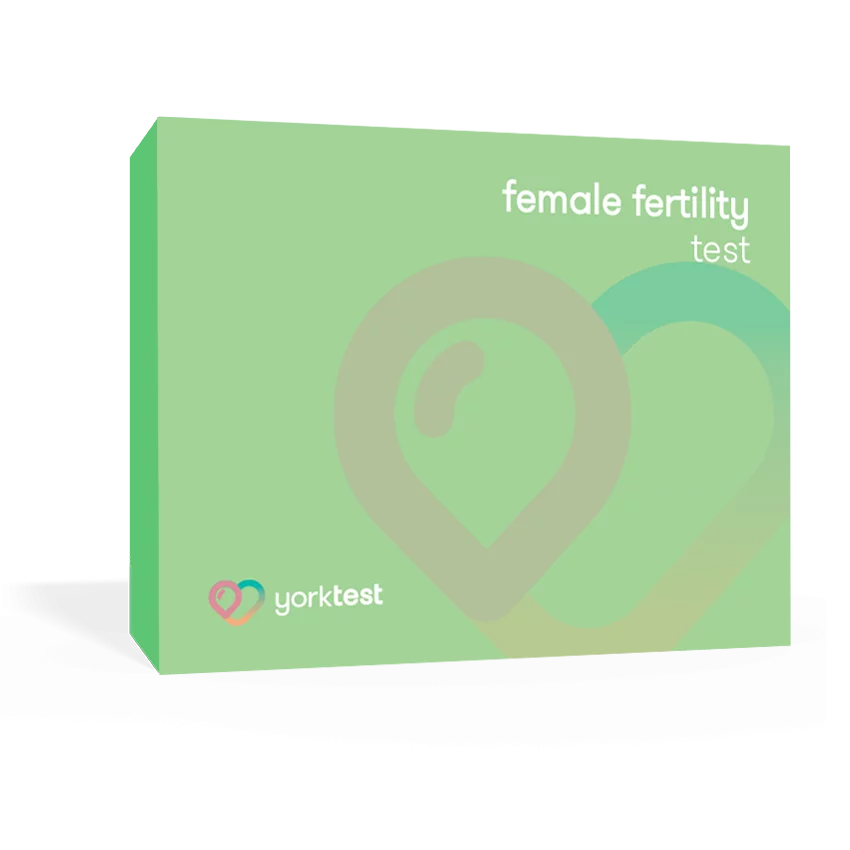
Female Fertility Test
Female Fertility Test by yorktest
This female fertility test provides you with valuable insights into your reproductive health from the comfort of your home. The test measures key hormones that indicate your ovarian reserve and overall fertility status, helping you understand your reproductive potential at your current stage of life.
You can use this fertility test women rely on to gain clarity about their reproductive health without needing to visit a clinic initially. The test analyses specific hormone levels that healthcare professionals use to assess fertility, giving you information that can guide your family planning decisions.
How This Home Fertility Test Works
The test works by measuring Anti-Müllerian Hormone (AMH) levels in your blood sample. AMH is produced by the small follicles in your ovaries and serves as an indicator of your remaining egg supply. Higher AMH levels typically suggest a larger ovarian reserve, whilst lower levels may indicate fewer remaining eggs.
You collect a small blood sample using the provided lancet and collection device, then send it to the laboratory for analysis. The laboratory uses established testing methods to measure your hormone levels and provides you with a detailed report explaining your results in clear, understandable terms.
Who Should Consider This Ovarian Reserve Test
This test suits women who want to understand their current fertility status, whether you're planning to conceive soon or considering future family planning. It's particularly relevant if you're approaching your thirties or forties and want to assess your reproductive timeline.
The test may be especially useful if you:
- Are considering delaying pregnancy and want to understand your fertility window
- Have a family history of early menopause
- Are experiencing irregular menstrual cycles
- Want baseline fertility information before making reproductive decisions
Many women find this information helpful when discussing family planning with their partners or when consulting with healthcare professionals about women's health concerns.
Understanding Your AMH Test Results
Your results will show your AMH level measured in picomoles per litre (pmol/L) or nanograms per millilitre (ng/mL). The report includes reference ranges that help you understand where your levels fall compared to typical ranges for your age group.
Higher AMH levels generally indicate a good ovarian reserve, whilst lower levels suggest fewer remaining eggs. However, it's important to remember that AMH levels naturally decline with age, and the test provides a snapshot of your current status rather than predicting your ability to conceive.
Clinical Considerations and Next Steps
This test provides valuable information, but it should be interpreted alongside other factors that affect fertility, including your overall health, lifestyle, and your partner's fertility status. AMH levels alone don't determine your chances of conception, as egg quality and other reproductive factors also play important roles.
If your results show lower than expected AMH levels, this doesn't mean you cannot conceive naturally. Many women with lower AMH levels still achieve successful pregnancies. Your results can help inform discussions with fertility specialists if you choose to seek further evaluation or treatment.
This product is a medicine. Speak to your doctor or pharmacist before using if you have an underlying medical condition or are taking other medicines.
Female Fertility Test by yorktest
This female fertility test provides you with valuable insights into your reproductive health from the comfort of your home. The test measures key hormones that indicate your ovarian reserve and overall fertility status, helping you understand your reproductive potential at your current stage of life.
You can use this fertility test women rely on to gain clarity about their reproductive health without needing to visit a clinic initially. The test analyses specific hormone levels that healthcare professionals use to assess fertility, giving you information that can guide your family planning decisions.
How This Home Fertility Test Works
The test works by measuring Anti-Müllerian Hormone (AMH) levels in your blood sample. AMH is produced by the small follicles in your ovaries and serves as an indicator of your remaining egg supply. Higher AMH levels typically suggest a larger ovarian reserve, whilst lower levels may indicate fewer remaining eggs.
You collect a small blood sample using the provided lancet and collection device, then send it to the laboratory for analysis. The laboratory uses established testing methods to measure your hormone levels and provides you with a detailed report explaining your results in clear, understandable terms.
Who Should Consider This Ovarian Reserve Test
This test suits women who want to understand their current fertility status, whether you're planning to conceive soon or considering future family planning. It's particularly relevant if you're approaching your thirties or forties and want to assess your reproductive timeline.
The test may be especially useful if you:
- Are considering delaying pregnancy and want to understand your fertility window
- Have a family history of early menopause
- Are experiencing irregular menstrual cycles
- Want baseline fertility information before making reproductive decisions
Many women find this information helpful when discussing family planning with their partners or when consulting with healthcare professionals about women's health concerns.
Understanding Your AMH Test Results
Your results will show your AMH level measured in picomoles per litre (pmol/L) or nanograms per millilitre (ng/mL). The report includes reference ranges that help you understand where your levels fall compared to typical ranges for your age group.
Higher AMH levels generally indicate a good ovarian reserve, whilst lower levels suggest fewer remaining eggs. However, it's important to remember that AMH levels naturally decline with age, and the test provides a snapshot of your current status rather than predicting your ability to conceive.
Clinical Considerations and Next Steps
This test provides valuable information, but it should be interpreted alongside other factors that affect fertility, including your overall health, lifestyle, and your partner's fertility status. AMH levels alone don't determine your chances of conception, as egg quality and other reproductive factors also play important roles.
If your results show lower than expected AMH levels, this doesn't mean you cannot conceive naturally. Many women with lower AMH levels still achieve successful pregnancies. Your results can help inform discussions with fertility specialists if you choose to seek further evaluation or treatment.
This product is a medicine. Speak to your doctor or pharmacist before using if you have an underlying medical condition or are taking other medicines.
Description
Female Fertility Test by yorktest
This female fertility test provides you with valuable insights into your reproductive health from the comfort of your home. The test measures key hormones that indicate your ovarian reserve and overall fertility status, helping you understand your reproductive potential at your current stage of life.
You can use this fertility test women rely on to gain clarity about their reproductive health without needing to visit a clinic initially. The test analyses specific hormone levels that healthcare professionals use to assess fertility, giving you information that can guide your family planning decisions.
How This Home Fertility Test Works
The test works by measuring Anti-Müllerian Hormone (AMH) levels in your blood sample. AMH is produced by the small follicles in your ovaries and serves as an indicator of your remaining egg supply. Higher AMH levels typically suggest a larger ovarian reserve, whilst lower levels may indicate fewer remaining eggs.
You collect a small blood sample using the provided lancet and collection device, then send it to the laboratory for analysis. The laboratory uses established testing methods to measure your hormone levels and provides you with a detailed report explaining your results in clear, understandable terms.
Who Should Consider This Ovarian Reserve Test
This test suits women who want to understand their current fertility status, whether you're planning to conceive soon or considering future family planning. It's particularly relevant if you're approaching your thirties or forties and want to assess your reproductive timeline.
The test may be especially useful if you:
- Are considering delaying pregnancy and want to understand your fertility window
- Have a family history of early menopause
- Are experiencing irregular menstrual cycles
- Want baseline fertility information before making reproductive decisions
Many women find this information helpful when discussing family planning with their partners or when consulting with healthcare professionals about women's health concerns.
Understanding Your AMH Test Results
Your results will show your AMH level measured in picomoles per litre (pmol/L) or nanograms per millilitre (ng/mL). The report includes reference ranges that help you understand where your levels fall compared to typical ranges for your age group.
Higher AMH levels generally indicate a good ovarian reserve, whilst lower levels suggest fewer remaining eggs. However, it's important to remember that AMH levels naturally decline with age, and the test provides a snapshot of your current status rather than predicting your ability to conceive.
Clinical Considerations and Next Steps
This test provides valuable information, but it should be interpreted alongside other factors that affect fertility, including your overall health, lifestyle, and your partner's fertility status. AMH levels alone don't determine your chances of conception, as egg quality and other reproductive factors also play important roles.
If your results show lower than expected AMH levels, this doesn't mean you cannot conceive naturally. Many women with lower AMH levels still achieve successful pregnancies. Your results can help inform discussions with fertility specialists if you choose to seek further evaluation or treatment.
This product is a medicine. Speak to your doctor or pharmacist before using if you have an underlying medical condition or are taking other medicines.